

A good print result begins long before the die reaches the printing press.
The more information we have about the design, substrate, technique and desired result, the more precisely we can determine how the die should be made. Plate thickness, etching depth, die material and manufacturing method are not universal - they depend on the specific application.
That is why we have highlighted seven pieces of information that are useful to define before ordering a magnesium or brass die.
1. What technique will the die be used for?
The first thing we need to know is what you want to achieve with the die.
- foil stamping
- blind embossing, i.e. a relief effect without foil
- blind (dry) stamping /branding
- embossing
- a combination of foil and embossing
- foil texturing
- other specific applications
The same design may require a completely different die depending on whether it needs to transfer foil, shape the substrate or create a complex relief.
The intended application is therefore one of the first pieces of information that should be specified when placing an order.
2. Magnesium or brass?
The die material should be selected according to the requirements of the specific project.
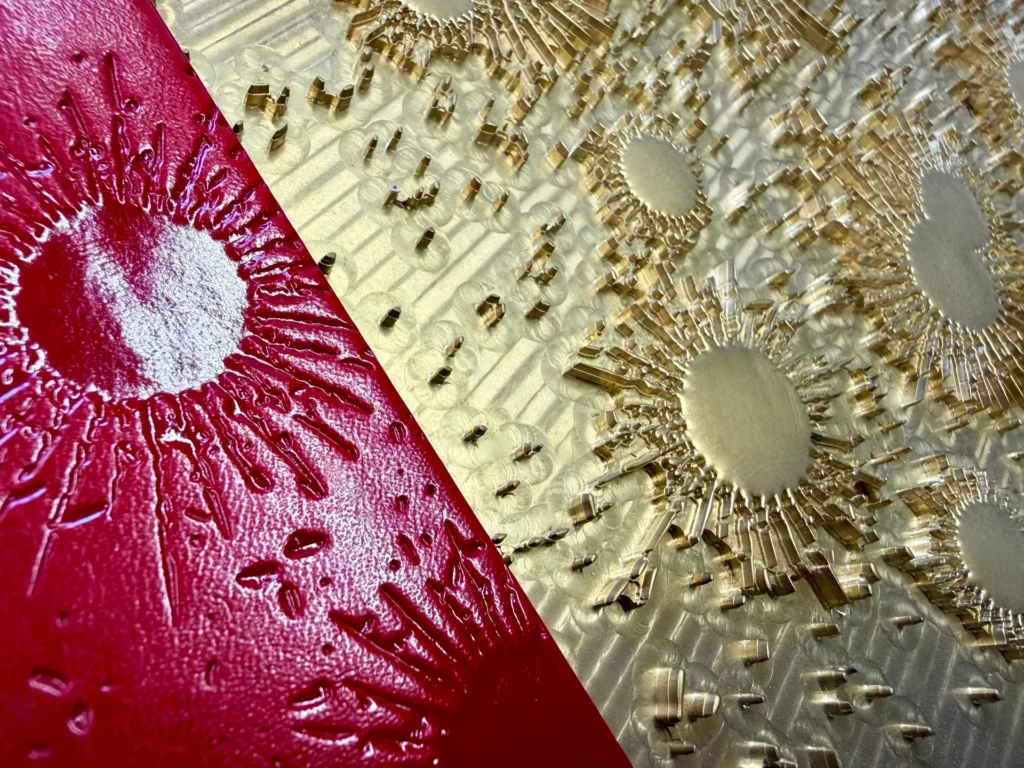
Magnesium dies are a highly practical solution for standard flat foil stamping, simpler designs, and small to medium production runs. They are produced by chemical etching, allowing fast production and an excellent balance between cost and quality.
Brass dies are produced using CNC engraving, which provides greater control over geometry, depth and engraving detail. Thanks to their strength and precision, they are particularly suitable for more demanding designs, larger and repeat production runs, embossing, multi-level reliefs, combination dies and textured dies.
If you are unsure which material is more suitable, you do not need to decide in advance. Based on the design, application, substrate and production run, we can recommend the appropriate solution.
3. What substrate will be printed?
Paper, board, coated materials and other substrates do not have the same properties.
Their thickness, hardness, surface structure and the way they react to pressure and temperature can all affect the final result.
For this reason, it is useful to specify the material or substrate on which the die will be used when placing an order.
This information is particularly important for relief applications, as the properties of the substrate influence how pronounced and precise the embossing can be.
4. What is the planned production run?
A die intended for a few hundred impressions does not necessarily have the same requirements as a die intended for a large production run or a product that will be printed repeatedly.
For small and medium production runs, magnesium is often a very efficient solution.
For large production runs or dies that will be used repeatedly, brass may be the better choice because of its greater mechanical resistance and durability.
Knowing the approximate production volume helps us recommend a solution that makes sense not only technically, but economically as well.
5. Is the artwork prepared correctly?
Die production requires vector artwork.
At Fibel, we accept: .CDR, .AI and .PDF
The design should be supplied at its original size (1:1), without scaling, mirroring or reversing to negative.
The file should contain only the elements to be reproduced on the die, i.e. the printing elements.
If the file includes registration marks, please specify whether they should remain on the finished die.
Correctly prepared artwork enables faster and more precise production preparation and reduces the need for additional checks before manufacturing.
6. What plate thickness do you need?
At Fibel, we manufacture magnesium dies in the following thicknesses: 1, 2, 3, 5 and 7 mm.
For brass dies, our standard thicknesses are: 3, 4 and 7 mm, while other thicknesses are also available upon request.
The appropriate thickness depends on the machine, mounting method, application and other technical production requirements.
If you already use a defined thickness on your machines, simply specify it when placing the order. If you are unsure which thickness you need, we can help you select the appropriate option.
7. Are there any additional technical requirements?
Sometimes a few additional details can make a significant difference when preparing the die.
For magnesium dies, this may include the required etching depth.
For other projects, registration marks, a specific substrate, mounting method or special application requirements may be important.
It is particularly important to let us know if the die will not be used for a standard printing application, but for mould making or another non-standard purpose. In such cases, we can adapt the manufacturing process to the actual function of the tool.
You do not need to have all the answers before ordering
Ordering a die requires a good understanding of the project, but you do not need to make every technical decision yourself.
If you are unsure whether you need magnesium or brass, which plate thickness to choose, or which etching depth is most appropriate for your application, send us your design, information about the substrate and a description of the desired result.
With more than three decades of experience in dies, foil stamping and graphic industry materials, our team can recommend a solution tailored to your project.
Artwork files for magnesium dies: info@fibel.hr
Artwork files for brass dies: mesing@fibel.hr